
'Was the five-day pause ever meant to hold, or was it simply another instrument of signaling, of positioning, of buying time in a war where even the pauses are tactical?' asks Prem Panicker in his must read daily blog on the Gulf War.

Taking Kharg would give the US control over virtually all of Iran's oil exports and thus provide significant leverage, notes Prem Panicker in his must read daily blog on the Gulf War. It would also put American troops within range of Iran's remaining missiles, drones, and artillery on a piece of real estate that is just eight square miles in size, and just 15 miles from the Iranian mainland.

'TTP has vowed to take revenge for the attacks that Pakistan is carrying out against Afghanistan.' 'To diminish this threat, Pakistan is hitting Afghanistan hard.'

The United States, which entered this war in expectation of a short, sharp win along the Venezuela model, is now preparing for deeper involvement in a conflict it does not fully control, without the allies it typically relies on, against an adversary that is not behaving as expected, in a global environment that is already absorbing economic shock. Prem Panicker continues his must read daily blog on the Gulf War.

India's handling of the Iran crisis reflects a growing strain between strategic autonomy and geopolitical alignment, observes Ambassador M K Bhadrakumar.

Alliances fight wars effectively only when they share an endgame. If Israel acted without US knowledge, then the military alliance is operating without real coordination at the level of strategic targeting. Neither picture is reassuring in a war that is no longer regional in its consequences. Prem Panicker continues his must read daily blog on the Gulf War.

Fight on toward goals that keep receding, or exit with most objectives unmet. Trump is agitated, his poll numbers falling below the Plimsoll line, his base fractured between those who back the war and those who remember that he campaigned on ending them.

The 98th Academy Awards was a mix of high fashion, subdued politics, flashes of humour and emotions running high.

'The entire US ecosystem built over decades at the bases in the Gulf region, especially the UAE, costing trillions of dollars have been decimated, dealing a mortal blow to the US Central Command's war capability,' points out Ambassador M K Bhadrakumar.

Prime Minister Narendra Modi visited Ethiopia on a bilateral visit, engaging with Ethiopian leadership to strengthen partnerships in various sectors. He was warmly welcomed by Prime Minister Abiy Ahmed Ali and participated in cultural events, highlighting the strong ties between the two nations.

The purpose of the delegation is to concretise relationships between the private sector in India and US universities, in hopes of a mutually beneficial partnership.

'I suspect that Bangladesh being given permission stuck in India's official craw, and this story was an attempt to balance the scales by giving the impression that a similar waiver had been given to India as well.'

When everyone has footage and no one can verify it, the loudest voice wins, notes Prem Panicker who begins a daily blog on the War in the Middle East.
Concerned over the decrease in the percentage of Indian students going to America for higher studies, the United States on Wednesday said it had plans to increase the number of visas for them and also speed up the visa issuance process.

Khaleda Zia, the former Prime Minister of Bangladesh and a dominant figure in the country's politics, has died at the age of 80 after a prolonged illness. Her career spanned decades and included periods of both power and controversy.

Trump's method are more destabilising than his policy. So, a good idea these couple of years is to sip Kool-Aid, and savour the joys of Trumplomacy, asserts Shekhar Gupta.

Presiding over the third Atal Bihari Vajpayee memorial lecture that was delivered by former Singaporean diplomat Bilahari Kausikan in New Delhi, Jaishankar also hailed Vajpayee's stint as an external affairs minister, and his role in strengthening India's ties with the United States and Russia.
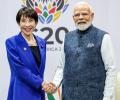
If they act now, they can reshape the strategic map of Asia without firing a shot. If they wait, the next opportunity will come only after a serious Taiwan Strait incident -- by which time the price will be far higher, and the room for boldness far smaller -- the opportunity may well be lost by then. The question is no longer whether this can or should be done, points out Varun Arya.

'The digital age has forced diplomats to be less formal and more accessible, reaching out to ordinary people both within and outside their countries, combining statecraft with streetcraft,' says former foreign secretary Ambassador Shyam Saran.

'There are times when India should stand up without hesitation and voice its indignation over the US' pressure tactic. This is one such moment,' asserts Ambassador M K Bhadrakumar.

The Congress party has claimed credit for the extradition of Tahawwur Rana, an accused in the 2008 Mumbai terror attacks, from the US, saying the Modi government did not initiate the process and merely benefited from the "mature, consistent and strategic diplomacy" begun under the UPA. Former Home Minister P Chidambaram said the government did not secure any breakthrough to make the extradition possible, nor is it the result of any grandstanding. He added that it was a testament to what the Indian state can achieve when diplomacy, law enforcement and international cooperation are pursued sincerely and without any kind of chest-thumping. Chidambaram detailed the UPA government's efforts in securing Rana's extradition, citing the registration of a case against him in 2009, diplomatic pressure on Canada and the US, and continued efforts despite legal setbacks. He highlighted the role of the UPA in securing Rana's conviction for other terrorism-related offences and the cooperation between the US and Indian agencies in gathering evidence and securing his extradition. The Congress leader further stated that it was the UPA's groundwork that paved the way for Rana's extradition, even after the change in government in 2014.

In the short run, the Trump presidency has already ensured one thing: The assumptions of the past can no longer guide the strategies of the future, points out Manish Dabhade.

External Affairs Minister Salman Khurshid on Tuesday said his ministry is contemplating a plan to have people from industry on-board to facilitate on issues relating to economic diplomacy.
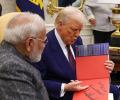
'The current strain in the relationship is serious and likely to be long lasting.' 'Even if Trump suddenly changes his attitude toward India -- which he is entirely capable of doing -- it is unlikely that New Delhi will be able to pick up the pieces and respond as if nothing has happened.'

India and China on Monday decided to resume the Kailash Mansarovar Yatra as the two sides agreed to take certain people-centric steps to 'stabilise and rebuild' ties.
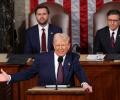
'Trump's desire to withdraw the US from some arenas on the global stage will result in ceding space to China.'
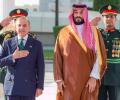
'Saudi-Pak defence pact is to anchor the defence and security of Saudi Arabia and not Pakistan, per se, with Islamabad being the junior partner.'
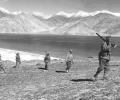
As India and China continue to face off across the Himalayas six decades later, the echoes of that earlier conflict remain unmistakable. The core of China's sensitivity lies not in maps or mountain passes, but in its perception of sovereignty over Tibet, points out Dr Kumar.

Mrs Gandhi's power ebbed and peaked with the times. Mr Modi's has almost been constant, barring the few months of hard dip after the 240 seats of 2024, points out Shekhar Gupta.

From just 0.2 per cent before the Russia-Ukraine war to now accounting for 35-40 per cent of total crude imports, India's reliance on Russian oil has surged -- drawing fresh scrutiny with US President Donald Trump announcing a penalty on top of a 25 per cent tariff, or tax, on all goods going to the US.

'The background for the Saudi-Pakistan agreement is the fact that the regional security order has collapsed due to the Israeli attack on Doha.' 'The Americans have largely abandoned their security guarantee for West Asia and the region has no choice but to look at alternatives.'
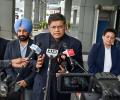
'It is high time that the 'war on terror' is removed from our diplomatic toolbox.' 'Certainly, our parliamentarians have no role in it,' asserts Ambassador M K Bhadrakumar.
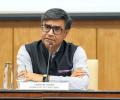
Foreign Secretary Vikram Misri, who faced trolling on social media in the wake of India and Pakistan reaching an understanding on May 10 to halt all military actions, has received support from veteran diplomat Nirupama Menon Rao, a body of Indian diplomats and a host of politicians from several parties.
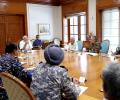
'One good outcome of Operation Sindoor -- perhaps, its best outcome -- could be that India has resumed meaningful contact directly with Pakistan at the military-to-military level,' observes Ambassador M K Bhadrakumar.
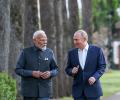
Speaking at a joint press conference with Belarus President Alexander Lukashenko on Thursday, Putin said that Russia agrees with the proposals to cease hostilities but "proceeds from the assumption that this cessation should lead to long-term peace and eliminate the root causes of the crisis."

Ambassador Natarajan Krishnan and Ambassador Shankar Bajpai helped shape Indian foreign policy at a glorious, but difficult, time in history, recalls Ambassador T P Sreenivasan.

'There is no question that Putin's preference will be to avoid unpleasantness with Trump, leave alone a collision course,' observes Ambassador M K Bhadrakumar.
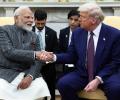
The real intention of the 'Tariff Man' (as Trump calls himself) may not even be to put the 'Tariff King' (as he describes India) on the mat with a knockout punch but to arm-twist the Indian leadership to agree to some multi-billion dollar mega arms deal, argues Ambassador M K Bhadrakumar.

Ministry of External Affairs officials summoned the Acting Deputy Chief of Mission Gloria Berbena at its office in South Block in Delhi and lodged a strong protest against a US State Department official's remarks on Kejriwal's arrest.
Alleging that Iran is evading its international responsibilities, the Obama Administration has accused Tehran of indulging in "rope-a-dope diplomacy".
